Gamdom represents a paradigm shift in online gambling, merging cryptocurrency efficiency with casino entertainment. Operating as a blockchain-based platform, it emphasizes transparency through provably fair systems and a vast library of third-party slots. This technical guide dissects the Gamdom slots ecosystem, from fundamental registration to advanced bankroll mathematics and cryptographic verification.
Before You Start: Prerequisite Checklist
- Cryptocurrency Wallet: A non-custodial wallet (e.g., MetaMask, Trust Wallet) with supported assets (BTC, ETH, USDT, etc.) is mandatory. Gamdom does not handle fiat currency.
- VPN Understanding: The platform operates in a legal gray area. Using a reliable VPN is standard practice, but ensure it doesn’t violate your local jurisdiction’s terms.
- Basic Crypto Literacy: Understanding transaction fees (gas), blockchain confirmations, and wallet security (private keys) is crucial.
- Responsible Gambling Tools: Familiarize yourself with Gamdom’s built-in limits (deposit, wager, loss) and self-exclusion protocols before depositing.
- Provably Fair Verification Readiness: Have a basic hash checker or note-taking method ready to verify game fairness manually.
Account Registration & Cryptographic Onboarding
Registration is streamlined, focusing on wallet association over personal data. Navigate to the official site and click ‘Sign Up’. You’ll provide only a username, password, and email. The critical step is wallet linking. Under ‘Deposit’, select your cryptocurrency. The platform generates a unique deposit address. Send a test transaction (a minimal amount) from your external wallet to this address. Confirmation on the blockchain (which can take from minutes to an hour depending on network congestion) simultaneously verifies and funds your account. Enable Two-Factor Authentication (2FA) immediately in security settings.
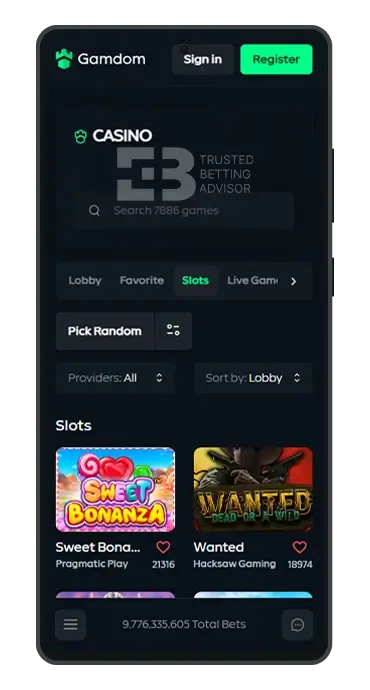
Mathematical Strategy: Calculating Expected Value & Wagering Efficiency
Success at Gamdom slots is a function of understanding expected value (EV). The formula is: EV = (Probability of Win × Payout) – (Probability of Loss × Bet). For a slot with a published RTP (Return to Player) of 96.5%, a $1 bet has a theoretical EV of -$0.035. However, bonus wagering drastically alters this. Suppose you claim a 100% deposit bonus up to 1 BTC with a 40x wagering requirement. You deposit 0.5 BTC, receive 0.5 BTC bonus, giving you 1 BTC total playable balance. The wagering requirement is (0.5 BTC bonus × 40) = 20 BTC. If playing a slot with 96.5% RTP, the expected loss while clearing the requirement is approximately (20 BTC × (1 – 0.965)) = 0.7 BTC. Since your bonus was only 0.5 BTC, the EV is negative. Strategy: Target high-RTP, low-volatility slots during wagering to minimize variance and maximize the chance of clearing the requirement with a balance left to withdraw.
| Category | Specification | Technical Implication |
|---|---|---|
| Software Providers | Pragmatic Play, Evolution, Hacksaw Gaming, et al. | Games are licensed content; RNG is provider-controlled, but outcomes are verified via Gamdom’s provably fair wrapper. |
| Provably Fair System | Client Seed + Server Seed + Nonce, hashed via SHA-256 | Players can verify each spin’s fairness post-game by comparing the revealed server seed hash to the initial committed hash. |
| Supported Cryptocurrencies | Bitcoin (BTC), Ethereum (ETH), Tether (USDT), Litecoin (LTC), +10 others | Multi-chain support reduces dependency on a single network’s transaction fees and speed. |
| Withdrawal Processing | Instant (after 1 confirmation for crypto) | No manual KYC checks for crypto, but large withdrawals may trigger automated risk assessment and source-of-funds queries. |
| House Edge / RTP Range | Slots: 94%-98%; Table Games: ~99% RTP (Blackjack) | The platform aggregates games; the overall player disadvantage is weighted by game choice. |
Banking Architecture: On-Chain Transaction Analysis
Gamdom’s banking is a direct blockchain interface. Deposits are on-chain transactions to a custodial wallet managed by Gamdom. Withdrawals are processed from their hot wallet. Critical Consideration: Network fees (gas) are always borne by the user. During Ethereum network congestion, a $20 withdrawal could incur a $15 gas fee, making small withdrawals inefficient. Strategy: Batch withdrawals into larger amounts and choose networks with lower inherent fees (e.g., Litecoin, Tron-based USDT) for smaller bankrolls. Monitor the internal ‘Pending’ status, which changes to ‘Completed’ once the transaction ID (TXID) is broadcast. Always verify the TXID on a block explorer.
Security & Provably Fair Verification Protocol
Security is a shared responsibility. Gamdom employs standard SSL encryption and cold storage for funds. The revolutionary feature is provable fairness for slots. Here is a step-by-step verification scenario for a Hacksaw Gaming slot: 1. Pre-roll: Before your spin, the game client generates a ‘Client Seed’ (you can change it). Gamdom provides a hashed ‘Server Seed’. 2. Post-roll: After the spin, the original Server Seed is revealed. 3. Verification: Combine the Server Seed, Client Seed, and the game’s nonce (spin number). Hash this string using SHA-256. The resulting hash determines the game outcome. You can replicate this hash off-platform using a tool like OpenSSL. If the derived outcome matches the game’s result, fairness is cryptographically proven. This process, while technical, is the core value proposition of the gamdom casino model.
Technical Troubleshooting: Common Failure States & Resolutions
Scenario 1: ‘Transaction Confirmed but Balance Not Updated’ This is typically a blockchain confirmation delay. First, check your deposit address on a block explorer. If confirmations are ≥2, use the ‘Support’ chat to provide your TXID. Do not re-send the transaction. Scenario 2: ‘Withdrawal Stuck on Pending’ This can indicate internal risk review. Contact support with your withdrawal ID. If it’s purely a network issue, they may re-broadcast the transaction. Scenario 3: ‘Game Failed to Load / Blank Screen’ Clear browser cache and WebSocket data. Disable ad-blockers and ensure WebGL is enabled. If persistent, the game provider’s server may be geoblocked in your region; try a different VPN endpoint. Scenario 4: ‘Provably Fair Verification Hash Mismatch’ Double-check that you are using the correct seeds and nonce in the exact order (Server+Client+Nonce). If a mismatch remains, document all data and contact support—this is a critical issue.
Extended FAQ: Technical & Operational Queries
Q1: Is Gamdom licensed, and how does that affect dispute resolution?
Gamdom typically operates under a Curacao eGaming license. This provides a regulatory framework, but dispute resolution is often limited to the platform’s internal support. The provably fair system is your primary audit tool.
Q2: What is the precise mathematical house edge on Gamdom’s in-house games like Crash or Dice?
For Crash, the house edge is embedded in the multiplier’s probability curve. A 1% house edge means the game’s expected multiplier is 0.99x. Dice games explicitly state the win probability and payout, allowing you to calculate edge directly: Edge = (Probability to Win × Payout) – 1.
Q3: Can I use automated bots or scripts to play on Gamdom?
Strictly prohibited. The Terms of Service forbid any form of automation or API exploitation. Detection leads to immediate confiscation of funds and account closure.
Q4: How are “max wins” regulated on third-party slots from providers like Pragmatic Play?
The max win is a contract between the provider and Gamdom. For example, a slot may have a max win of 5,000x the bet per spin. This is enforced at the game server level, not by Gamdom. Hitting this cap will stop the bonus round or spin.
Q5: What happens to my balance if a cryptocurrency hard forks while it’s deposited?
This is a complex custodial issue. Generally, if Gamdom controls the private keys for the deposit wallet, they retain the forked coins. Their policy on crediting users varies and is rarely favorable. Withdraw funds before known fork events.
Q6: Does playing with different cryptocurrencies affect my RTP or odds?
No. The game mathematics are independent of the currency used. The value of your bet is simply converted to a fiat equivalent (e.g., USD) at the current exchange rate at the moment of the bet.
Q7: What is the data retention policy, and can I request full game history for tax purposes?
Under AML policies, data is retained for years. You can export your bet history via the ‘Reports’ section, which provides CSV files with timestamps, bet amounts, game IDs, and outcomes—sufficient for most accounting.
Q8: If the Gamdom site becomes inaccessible, how can I verify the status?
Check blockchain explorers for recent withdrawals from their known hot wallets (visible from past TXIDs). Community channels like Discord or Telegram often have real-time status updates from other users.
The gamdom slots platform is engineered for the technically-inclined gambler who values cryptographic transparency over traditional licensing narratives. Its viability hinges on the user’s ability to navigate blockchain mechanics, verify fairness proactively, and apply rigorous bankroll mathematics. While offering near-instant settlement and global access, the technical overhead and regulatory ambiguity constitute significant trade-offs. Ultimately, Gamdom serves as a functional case study in decentralized gambling’s current capabilities and limitations.